

James and I went to Paris over the holidays for our honeymoon! (It was fun. It was very cold! I ate many croissants.) We were mesmerized by the sculptures, painted ceilings, paintings, and architecture in the Louvre.1 We explored every cathedral and basilica we walked past, and found the Panthéon to be a surprising highlight as well.


It felt as though everything had a purpose—it wasn’t just pretty to look at, but it was making a statement: why it needs to exist, why it should last, why you should feel awe. These paintings and structures were beautiful because they each contained a thesis, a devotion to an idea left behind by the artist.
Take cathedrals: at their best, a pure-hearted intention behind these was to build a house that might hint at the awesomeness of their god.2 The tall ceilings draw your gaze toward heaven, the light filters through the stories in the stained glass windows, and the intended silence implies a reverence. And if you look closely, there are infinite details; each church is not quite like the next.
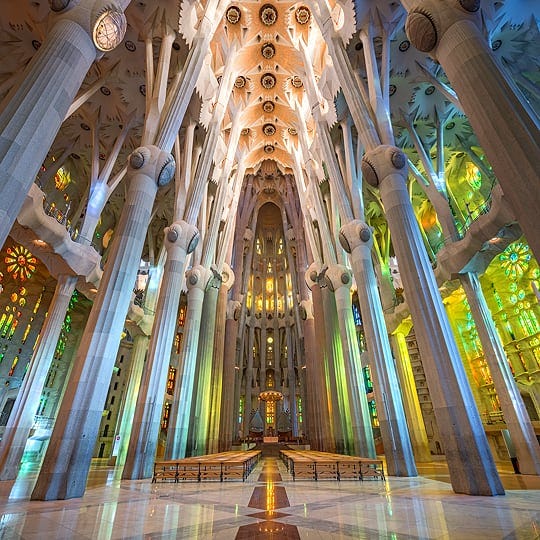
While seeing the French cathedrals, I felt a similar emotion to when I saw La Sagrada Família, Antoni Gaudí’s famous unfinished basilica in Barcelona. 2026 marks the 100th anniversary of his death, and the basilica is still not finished. What could possess someone to devote their entire life to building something they would never get to see complete? I know his famous line is “My client is not in a hurry,” but still—to build something with such devotion and conviction requires a sacrifice I can’t fathom.
I really hate this quote from Jeremy Tate, because I think it’s true:
Modern man is in a terrible predicament. He is helplessly enamored with the beauty of what the old world built, yet despises the beliefs that inspired them to build it.
In order to make something truly beautiful, it has to cost something. It can’t be so easy. Religion was a big motivator in Old World Europe, and so was status-signaling, the desire to control your enemies, and narcissistic tendencies (cough, Versailles). These intentions varied across the moral spectrum, but they left behind lasting monuments that we still cherish to this day, because they made a statement about something.
America, too, had a period where we expressed our belief in the future and the power of trade and capitalism, or our belief in democracy through our architecture—the Empire State Building and monuments in Washington, D.C. are famous examples, built around a century ago.
When I see newer structures, however, I don’t get the same sense of awe or inspiration—instead, they leave me feeling hollow. I walk past our megalomaniacs’ delusions of grandeur, knowing many of these serve commercial purposes, meant to optimize a city’s profits. I even live in a cookie-cutter glass-paneled building constructed with the cheapest materials and fewest customizations (in the “name” of modernism, eyeroll). If anything, we are signaling our lack of thought, as landlords guiltlessly sell us 15-foot-long hallways, triangular closets, or other odd dead spaces that honestly belong in purgatory.3
I think these exist not only in America but in every country where hypergrowth has prioritized scale and cost-efficiency over intentionality.
We visited Beijing earlier this month, to see James’s grandfather, a former architect. His critique of Beijing’s many government buildings from his era was that they might look big from the outside, but inside everything is dim and the ceilings are short. They were built for efficiency and conformity, and all the interiors have the same dull vibe no matter the building’s purpose. He preferred the buildings of Europe, and even Shanghai, that were tall and let in light and gave you something to aspire toward.
In contrast, I thought of the ambition of the Bird’s Nest and Water Cube, designed from scratch to teach the world of China’s modernity as they hosted the Summer Olympics in 2008. Or the Forbidden City and the many temples throughout Beijing, still preserved and maintained from the Ming and Qing dynasties, to give the people a sense of their history half a millennium later.
Beauty we make has a thesis, and a real work of beauty keeps reminding you it exists.
There’s a present discourse I like about how people are pursuing more analog hobbies in 2026, to “protect more human-made things.” These stand out to me as hobbies that require investment through persistence to see a result—many of these require practice before we make anything we feel proud of. Practices like:
Reading/writing longform content: Longform forces depth of thought and analysis, and fails otherwise. There’s a clear thesis, often supported by research, and a necessary organization and building-up of thoughts and stakes in order to deliver a point that matters.
Film photography: Film often captures a precise and often imperfect moment—maybe we didn’t adjust the exposure right, there was a light leak, someone forgot to smile—and costs money to take a photo and develop it. But what we get back feels more precious, perhaps because it reflects the beauty of being in the moment and rejects artificial perfection.
Tactile hobbies: ceramics, leatherwork, painting, knitting, furniture making—there is something that feels real about beating the shit out of clay, watching colors mix on a palette, or feeling the meditative and rhythmic beats as you get the hang of knitting. Moving your body doesn’t have to just be through exercise; crafting can also allow us to feel more grounded.
While on the surface, folks claim this is about “fighting against AI,” I actually believe this is about using our actions to define and defend what we believe is truly beautiful.
I don’t actually believe AI is inherently evil (though it is a shame it has been trained on so much plagiarized work), but what feels wrong is how so much generative “art” is inundating our fields of attention with nothing.4 It feels as though social media is now full of AI content to keep people scrolling, numbed and entertained, by pretty colors and images that don’t exist in reality—when these platforms started out trying to foster human connection.
What are you trying to say about the world?
What are you trying to teach me about myself?
Are you trying to say anything at all?
Anyone can feel empty living with so much noise and no message. No wonder we want to unplug and find real beauty, something indisputably real, knowing that it cost something to have brought it into the world—be it an opinion you need to defend, a story that risks embarrassment, effort and time with no promise of payback. To create is to tell the world that this idea deserves to be born, this idea matters, that this is your idea of beauty.
With each coming day, it’s harder to tell the difference between what’s real and what’s not online. But I think when we choose to train our attention on what’s truly beautiful to us, we find what inspires us and not just what’s “pleasant to the eye” or “perfect.” In doing so, we find more meaning and happiness, despite the circumstances of our modern world.
Here’s to a 2026 filled with more of what’s really beautiful.
We decided the Mona Lisa is the world’s most overrated painting—like we would have just walked past it if it didn’t have every sign in a half-mile radius pointing to it AND an entire half-gallery to itself. Apparently this is a VERY common take, according to my Instagram story replies.
A long time ago, when I was still in college, my friend Geoff took me to visit the Cathedral of Our Lady of the Angels, aka the LA Cathedral. Oh, how I hated that building, which I only knew as an eyesore off the side of the 101! But Geoff taught me everything about cathedrals and how every detail, like the fact that the windows were made of alabaster, a precious material from Jesus’s time, were all decisions that conveyed the worship and intent behind those that designed it. He taught me to see the beauty in the intentionality of that weird and wacky building.
Sorry, was having too much fun with the weirdly religious overtones of this post.
To be clear, I still think it’s possible for AI-generated or AI-enabled art to be real art. I believe intentionality, cost, and belief matter the most for something to be beautiful. Because the cost to the creator can be lower, my bar for what impresses me is higher—kind of like how I’d be more amazed by a hand-sewn handbag than a 3D printed one.
"I actually believe this is about using our actions to define and defend what we believe is truly beautiful."
GUH, so true! Beautiful-ly written, appreciated this meditation on the role of beauty applied in our environs.
Love this!